
HISTORY
Its foundation.
In 1530, Fray Domingo de Mendoza, evangeliser of the New World, founded a hermitage previously erected by the adelantado Alonso Fernández de Lugo in honour to the the Archangel San Miguel who led the military conquest and patron saint of the island.
In July 1553, Calvinist Huguenot pirates, under the command of Pie de Palo, took Santa Cruz de La Palma for a month, sacking and burning houses, churches and convents, including Santo Domingo.
The reconstruction after the fire was carried out by means of alms and contributions from the lords who lived on the island.
Its Splendour.
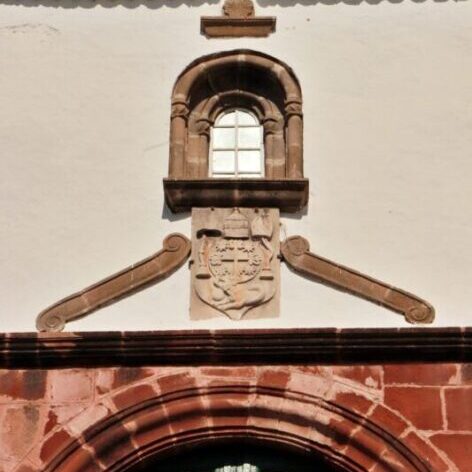
The Church of Santa Domingo was rebuilt after the fire caused by French pirates in 1553. Its interior has a single nave with side chapels (Latin cross plan), covered with Mudejar polychrome and gilded frames. A number of different artistic styles coexist aesthetically, such as Renaissance, reflected in its architecture, Baroque, present in its altarpieces with Solomonic columns, and Neoclassical, represented in its sculptural works.
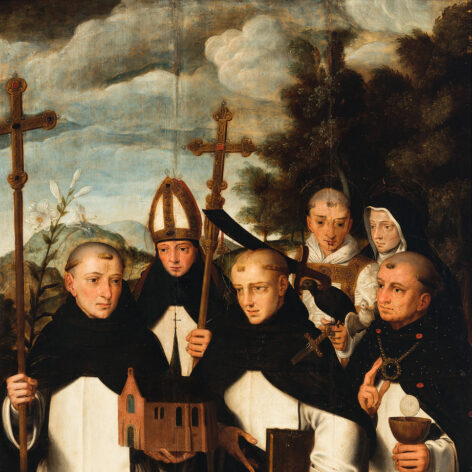
It houses Flemish paintings by Pierre Pourbous the Elder and Ambrosius Francken, a Baroque altarpiece with Solomonic columns considered the best in the Canary Islands, the images of the Venerable Brotherhood of Jesus the Nazarene and Our Lady the Virgin of the Rosary.
At the beginning of the 18th century, the temple would become one of the most sumptuous in the Canary Islands, with studies of philosophy and theology shining with their own light in art and literature.
Its decline.
As a result of the disentailment (1836) and the abandonment of the monks of the convent of Santo Domingo, the building began to decay and was abandoned and used for a multitude of services. In the second half of the 20th century it was acquired by the Cabildo Insular de La Palma and the High School Alonso Perez Diaz was built.
Nowadays, the church, the tower, the Cristo de la Portería and some rooms currently used by Cáritas are still standing.
The Church of Santo Domingo had been relegated to the background and it was difficult to imagine what one could see inside, resulting in a blurred reflection of the religious history of the city in contrast to the opulence of the Dominican order. Until its opening for public visits in 2025.