
THE NAZARENE AND HIS BROTHERHOOD
THE NAZARENE AND HIS BROTHERHOOD
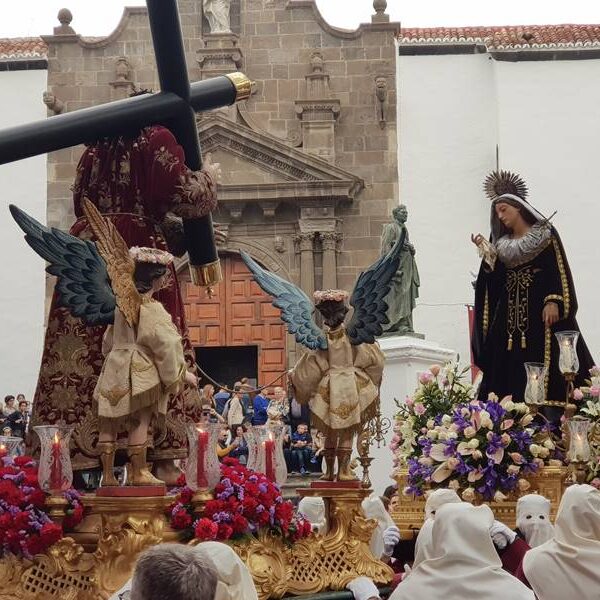
One of the most devout images that the convent of San Miguel de La Palma had was that of Jesús Nazareno, guarded by its Venerable Brotherhood, established in the church of the Dominican friars since 1667. Despite the vicissitudes, after the re-foundation in the 80’s of the 20th century, this Brotherhood still exists. Of special significance is the richly decorated platform on which the image of the Nazarene, made of gilded wood in rococo style, is carried in procession every Holy Wednesday, together with the box in which it was sent to the island from Cuba; the four elegant Angels of the Passion that crown its corners, dressed in the Roman style, made in Havana in the second half of the 18th century; These were donated by the rich landowner from La Palma and devotee of Jesús Nazareno, Cristóbal Pérez Volcán, as well as the marvellous tunic of crimson velvet embroidered in gold, of Andalusian origin, from the 1770s, considered to be the best of its kind in the Canary Islands.
The Venerable Brotherhood of the Nazarene undertakes the task of renewing its furnishings and images for the procession on Holy Wednesday. The images of Jesús Nazareno and Nuestra Señora de los Dolores, popularly known as ‘La Magna’, were commissioned from the sculptor Fernando Estévez; the sculpture of San Juan Evangelista was the work of Manuel Hernández ‘El Morenito’. This procession on Holy Wednesday includes the secular para-theatrical ceremony of the Holy Meeting, popularly known as the ‘Point in the Square’ where the meeting of the Virgin with Christ carrying the cross, on the way to Calvary, is represented. Two snapshots of this ceremony can be seen on the exhibition table: the first is a copy of a stereoscopic photograph taken by a tourist of the time, dated around the 1860s; while the next is taken from the window of the tower of the parish church of El Salvador around 1899.
Worthy of mention is the Standard of the Venerable Brotherhood of the Nazarene, made of purple velvet, embroidered in gold, around 1870, as well as the Guion, also made of purple velvet, embroidered in gold, from the middle of the 19th century.