
CHAPEL OF SAINT THOMAS OF AQUINO OR OF THE LORD TIED TO THE COLUMN
CHAPEL OF SAINT THOMAS OF AQUINO OR OF THE LORD TIED TO THE COLUMN
The chapel dedicated to St. Thomas Aquinas was built by the Flemish knight Louis Van de Walle, known as ‘The Old Man’, and was under construction in 1554 and already built in 1567. It was presided over by a large painted altarpiece depicting the story of the Blessed Sacrament and the Manna. After the extinction of the convent in 1836, this altarpiece was dismembered and its whereabouts were unknown until a few years ago, when this group of paintings was identified in various collections in Tenerife. After study, it could be the work of the Dutch painter Jan Swart van Groningen around 1547. Of this ancient altarpiece, only the original altar table remains, with a front covered with 16th century Sevillian tiles, hidden behind another wooden one donated in 1792 by Fray Pedro García.
Also surviving, as a symbol of privilege, is the entrance for private use that allowed the chapel’s patrons to enter directly from the street and climb up to the latticed tribune, through which they could follow the religious service without being seen. It was built behind the altarpiece of the Virgin of the Rosary in 1730, under the patronage of Don Luis José Van de Walle Cervellón, who also obtained permission to open a window to be able to see the pulpit from the tribune.
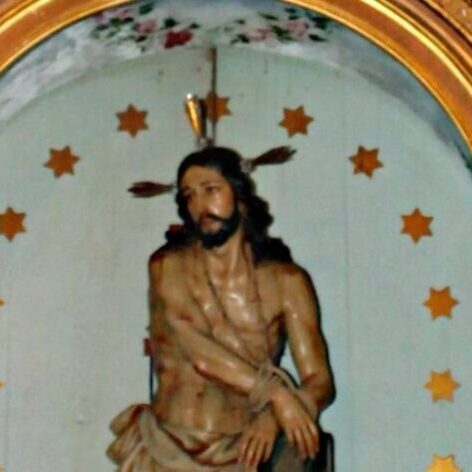
Today, the chapel is presided over by an ornamental altarpiece that could have been in the nave of the church or in a chapel in the convent cloister. It is a Mannerist altarpiece with Plateresque decorations from the last third of the 17th century. The altar is presided over by the image of the Lord tied to the Column, a mid-20th century work by the sculptor Andrés Falcón San José, which is carried in procession on the night of Holy Tuesday. The second section is framed by the painting of Saint Louis King of France, patron saint of the Van de Walle family, modelled on the Flemish sculpture of the same saint that is venerated in the Matriz de El Salvador parish church.
The chapel is enclosed by a 16th-century Mudejar ceiling, decorated with lacework that runs along all the skirts, which are decorated with a dazzling polychromy based on vegetal rosettes, floral motifs and themes inspired by Renaissance grotesque, arranged symmetrically in the frieze.