
CHAPEL AND HIGH ALTAR: ALTARPIECE, PULPIT AND CHOIR ENSEMBLE
CHAPEL AND HIGH ALTAR: ALTARPIECE, PULPIT AND CHOIR ENSEMBLE
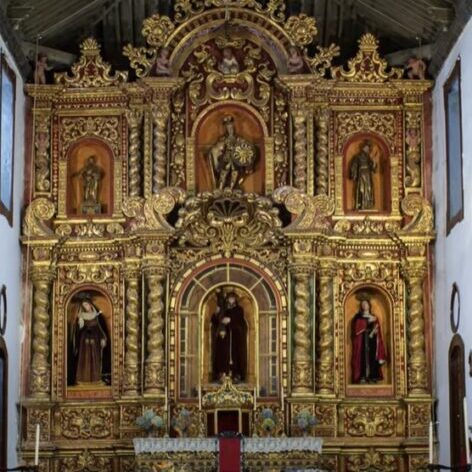
Around 1700, an ambitious renovation project was begun in order to reaffirm the importance of the convent and to create a symbol of the power of an Order distinguished, among other things, in the field of the arts. Several Dominican friar artists, sculptors and painters played an important role in the undertaking, decorating almost exclusively the church and the convent. The first years were a time of great activity, both in the feverish decorative work, of great baroque style, and in the creation of an iconographic programme to glorify the triumph of the Church and the Order of Preachers. This important undertaking was encouraged by Fray Andrés Maldonado. The renovation began with the main chapel, whose walls were raised and the reconstruction of the ceiling, and by 1702 work was already underway on the construction of the new altarpiece, the work of Juan Lorenzo, which was completed in 1705, the pulpit and the convent choir. Gilded in 1751, the main altarpiece has been defined by the historian Trujillo Rodríguez as ‘the most beautiful, complete and baroque example of the altarpieces with paired Solomonic columns and two sections existing in the archipelago. It also represents the appearance of the Solomonic column on La Palma. The altarpiece still bears, as an unequivocal symbol of patronage, the arms of Santa Cruz, on the main side of the Gospel, and those of Cervellón, on the Epistle, carved with thick and bulky baroque carving.
Two friar-artists who had in common the fact that they were lay brothers were prominent in these works: the sculptor Fray Marcos Gil and the painter-decorator Fray José de Herrera. Friar Marcos was commissioned to make the sculptures for the main altarpiece and the pulpit, among others. The triumphant Saint Michael who presides over the main altar, dressed as a Roman warrior, armed and victorious, is probably from his gouge. This is the iconography of the saint as a prince and commander of the heavenly host, holding a shield and baton of command, an iconographic idea that is widely represented in 18th-century paintings of this saint. This altarpiece also worships the images of Saint Francis of Assisi, on the Epistle side, a 17th century work from the mountains, donated by Captain Antonio Pinto de Guisla; and the sculpture of Saint Joaquín, on the Gospel side, the only sculpture of this saint on the island. The images of Jesús Nazareno, Nuestra Señora de los Dolores, popularly known as ‘La Magna’, the work of the sculptor Fernando Estévez in 1841, and San Juan Evangelista, the work of Manuel Hernández ‘El Morenito’ from 1843, take centre stage in the first body of the altarpiece. These three images are carried in procession on Holy Wednesday in the traditional ‘Encuentro’ or ‘Punto en la Plaza’ (Meeting in the Square).