
CAMARIN
CAMARiN
The place where we find ourselves is the Camarín de Nuestra Señora del Rosario, a room that resembles the Royal Chamber or the Sancta Sanctorum, built between 1697 and 1698 next to the chapel of the Virgin, built by the master Domingo Álvarez and under the priory and stewardship of the Brotherhood of the Rosary, Fray Andrés Perera, who had the camarín made so that the holy image could dress and undress in it, so that the ritual could be performed in a more dignified manner.
The clothing of the Virgin of the Rosary is heir to the style of court dress, whose most characteristic features had been defined in the mid-16th century, under the reign of Emperor Charles V and his son Philip II. This style of apparel worn by leading women, such as Queens and Princesses, placed special importance on erasing the natural forms of the body through bodices lined with cardboard and the inner welt that gave rigidity to the skirt, accentuating the contrast with the narrowness of the waist and the large lower hem. All this evolved in the 18th century with the arrival at Court of the Bourbon dynasty and the more French taste, exemplified by the pompous cloaks and the broadness of the basquiña. In the 19th century, a more natural taste in dress began to emerge, without losing the forms inherited from previous centuries. Thus, the clothing of Our Lady of the Rosary consists of several pieces such as: the Basquiña, which is the outer skirt or skirt, always accompanied by the inner welt that gives it the flared shape; the Jubón, also called the breastplate or bodice, and, separately, the sleeves and cuffs that are placed independently of the doublet; and finally the headdress, framing the head of the Virgin and covered by the mantle. All this can be seen in the photographic reproduction of the Virgin of the Rosary, one of the most reproduced photographs of the Virgin, taken by the photographer Otilio Rodríguez Quintero in around 1934, the year of the premiere of the white lampaseta costume embroidered in gold, bought from the Casa Aranda in Saragossa.
The dresses are made with different fabrics and colours, in silk, taffeta, damask, lampazo, tisu and lamas, brocades or fabrics worked with silk, gold and silver threads; fabrics to which gallons, trimmings and fine gold fringes were added. In the display cases we can see a set of three of the oldest bodices that the Marian image has, as well as several cuffs from different costumes of the Virgin, showing the range of colours and the different fabrics in which the wardrobe of the Virgin of the Rosary is made. Also on display is the so-called ‘Mourning’ costume, a fabric from the beginning of the 19th century, defined in the inventories as a ‘suit and mantle with golden bouquets’.
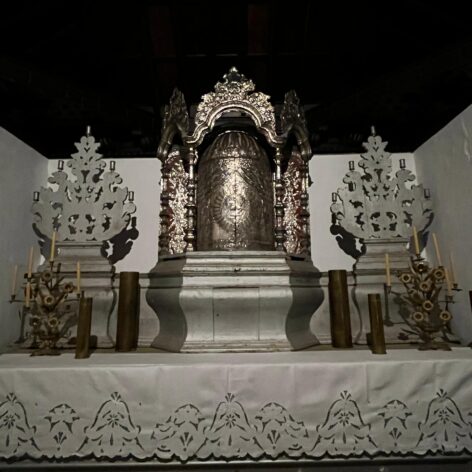
Another function of this sacred room was to store the most valuable items belonging to the Brotherhood of the Rosary or to the church. This is the case of the Altar-festive or sotabanco of the Virgin of the Rosary, which includes the Baroque manifester, made of silver from the mid-18th century; the two angels painted on a panel to decorate the festive altar of the Virgin, which may be the work of Aurelio Carmona López, from the end of the 19th century. All this apparatus, together with the large canopy in the Chapel of the Virgin, can be seen in the photographic reproduction, dating from the 1940s. The mother-of-pearl and tortoiseshell Cross with the Armas Christis or symbols of the Passion and the two lecterns of the same precious materials, adorned with the anagrams of Jesus, Mary and Saint Joseph, all surrounded by a rosary supported by angels. These works could be objects that came from Mexico in the 18th century; or a set of Elizabethan porcelain vases from the end of the 19th century or the curious vases made by using real bullets, donated to the Virgin of the Rosary in the form of an ex-voto by Colonel Luis de Miranda Beautell.