
FLEMISH PAINTINGS
FLEMISH PAINTINGS
After the pirate attack of ‘Pie de Palo’ in 1553, the Dominican convent was rebuilt by the leading families. This is the case of the construction of the main chapel at the expense of Don Juan de Santa Cruz, lieutenant general of La Palma and lieutenant governor of Tenerife, conqueror of Malabueys and governor of Cartagena de Indias, who had an altarpiece of paintings brought from Flanders to decorate the main chapel, where his coat of arms and portraits of himself and his wife Juana Luisa de Cervellón appeared.
The paintings that made up this altarpiece, representative of the Mannerism of the Bruges school and attributed to Pierre Pourbus ‘the Elder’, were dismembered from their original frame in 1703, when the current Baroque altarpiece was built.
The iconographic message of this altarpiece represents the triumph of Catholic doctrine over heretical deviations, a confrontation which, at the time, was dividing the European map.
– The panel of the Archangel Saint Michael, patron saint of the Dominican convent of San Miguel de La Palma, is shown beating the devil, holding a sword aloft and carrying the scales, symbol of the particular judgement to which the soul of the faithful is subjected after death, represented by a nude figure in a praying attitude, on one of the trays, which the devil tries to tilt in his favour. Saint Michael is depicted as a hero in Roman costume, representing the Catholic Church and fighting against heresy, represented by the devil.
– The panel of Saint John the Baptist points with his finger to the lamb, symbol of the sacrifice of the Passover supper, where Christ instituted the Eucharist, a sacrament denied by the Protestant Reformation; in the background we see the preaching of the Baptist amidst the nature of a forest.
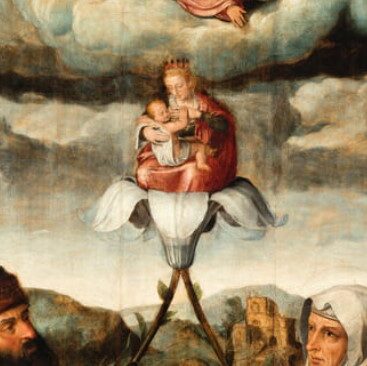
– In relation to the Virgin Mary is the panel of The Genealogy of Jesus and the Tree of Jesse, which is inspired by the words of the prophet Isaiah: ‘And a rod shall come forth from the root of Jesse, and a flower shall grow out of his root’; it depicts Saint Joachim and Saint Anne, the Virgin’s parents, with a lily rod sprouting from them, whose flower opens to show the Virgin and Child. This iconographic theme of the Tree of Jesse, according to the historian Trens, was the graphic form of presenting the virginal conception of Mary until the creation in the 16th century of the iconography of the Immaculate Conception of Our Lady.
– The iconographic message of the altarpiece is reinforced by the panel of the Dominican Saints, the most distinguished saints in the fight against heresy. On the right wing and in the front row are: Saint Dominic of Guzman trampling on the devil; Saint Peter Martyr of Verona, who crushes the body of a soldier with his foot, another figurehead of heresy; and Saint Thomas Aquinas, a firm bastion of the doctrinal orthodoxy of the Church. Other saints such as Saint Albert and Saint Catherine of Siena also appear.
By placing the panels of Saint John the Baptist, The Genealogy of Jesus and the Dominican Saints correlatively, it is possible to see how the line of land, the landscapes and the sky continue from one to the other.
Apart from the panels of the missing main altarpiece, the church has a large canvas, important for its quality and iconography: The Holy Supper, signed by the Antwerp painter Ambrosius Francken (1544-1615), is considered by scholars to be the most representative painting of Michelangelesque Romanism in Flemish Mannerist art in the Canary Islands. It was not initially commissioned for the church, as until 1621 it presided over the main room of the house of the Santa Cruz family, descendants of the bachelor Santa Cruz, the donor of the old main altarpiece. Curiously, the painter’s signature can be found on the knife wielded by one of the apostles, who could well be Saint Bartholomew, as this is his iconographic symbol.
Finally, the grisaille panels of Saint Francis of Assisi and Saint Blaise the Bishop belong to the old main altarpiece, donated by the licentiate Santa Cruz. The grisaille panels are the doors that closed the old altarpiece, something very common in the altarpieces of the period. These paintings were generally monochrome, in shades of grey, achieved through gradations of black and white. They simulate unpolychromed stone sculptures with the figures in a frame or niche, placed on pedestals. In the present case, Saint Francis and Saint Blaise appear inside a niche on a pedestal and, to reinforce this idea, the painter brings the leg forward to the very edge of the pedestal to give much more movement and thus reinforce the lively appearance of the figures. The use of colour in flesh tones, as in the present case, is very common in 16th-century grisaille, particularly in Bruges, the city of the painter to whom it is attributed, Pierre Pourbus ‘the Elder’.